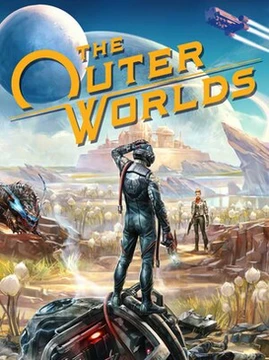
Django
A bounty hunter running from the very corporation that made him a target.

Django is a wanted bounty hunter encountered during the player's journey through the Halcyon colony in The Outer Worlds. A large, imposing figure with a rough past, he is on the run from the Constellation and becomes entangled in the crew's orbit when the player crosses his path. His presence injects a tense, morally ambiguous thread into the game's broader narrative of corporate overreach and survival.
As a quest NPC rather than a companion, Django serves as a test of the player's alignment: you can choose to aid a desperate man trying to stay one step ahead of corporate kill-squads, or you can cash in on the bounty the Constellation has placed on his head. Either way, the encounter highlights the game's recurring theme that in the Outer Worlds, loyalty is a commodity and survival is the only currency that matters.
- Role
- Bounty hunter / Wanted criminal (quest NPC)
- Affiliation
- Independent; hunted by the Constellation
- First appears
- The Outer Worlds (2019)
- Player interaction
- Quest-giver; can be helped or turned in
- Companion status
- No (non-companion NPC)
Lore & Background
In the lawless sprawl of the Halcyon colony, the Constellation's reach is nearly absolute, and those who cross it rarely get a fair trial. Django carved out a living as a bounty hunter in the early days of the colony, tracking down outlaws and corporate defectors for a steady paycheck. But the line between hunter and hunted grew thin, and one job too many put a price on his own head. Now he slips through back-alley bars and dusty outposts, always looking over his shoulder, always one step behind the Constellation's enforcement drones.
His story is a microcosm of the game's central tension: the Constellation presents itself as the benevolent architect of a new frontier, yet its methods are those of a private army enforcing corporate will. Django's existence—skilled, dangerous, and now a target—exposes the hypocrisy of a system that rewards violence in service of profit and then punishes the same violence when it turns against the employer. Whether the player chooses to protect him or collect the bounty, the encounter forces a reckoning with who the real criminals are in the Outer Worlds.
Fans often cite Django as one of the game's more memorable one-off encounters precisely because he is not given a save-or-recruit arc. He is a moment of moral friction, a reminder that the Halcyon's population are not just quest markers but people caught in a corporate machine that grinds them to dust.
In Their Own Story
The neon sign above the bar flickers, buzzing like a dying wasp. Django sits in the corner, boots up on the sticky table, a glass of something amber sweating in his thick fingers. He doesn't look up when the door creaks open. He doesn't need to. He's been counting the seconds between the Constellation patrol drones' overhead hum for three days now, and he knows the gait of the man walking in—the slight drag on the left, the way the coat sways a half-beat behind the stride.
"You're either here to save me or collect me," Django says, still not looking up. "Both of 'em pay the same, so I don't much care which. Sit down. You look like you've got a long story and a short fuse."
Outside, the colony's perpetual twilight presses against the glass, and somewhere far off, a siren wails in a key that doesn't quite resolve. Django finishes his drink, sets the glass down with a soft clink, and finally meets the stranger's eyes. They are tired. They are not afraid. There is a difference, and in the Outer Worlds, that difference is the only thing keeping a man alive.
Reader's Guide
Django is a bounty hunter and wanted criminal you encounter during your time exploring the Halcyon colony. You first cross paths with him in a tense, low-key setting where he is clearly on the run, and the encounter kicks off a short quest chain that tests your moral compass.
Personality-wise, Django is blunt, world-weary, and physically imposing. He doesn't sugarcoat things and speaks like a man who has already lost more than he can afford to lose. He is not hostile to the player, but he is guarded, and his dialogue carries the weight of someone who trusts no one for good reason.
The key choice revolves around whether you help Django evade the Constellation's pursuit or turn him in for the bounty. Helping him can involve a small escort or stealth element, while turning him in is a quick, transactional decision that earns you credits and Constellation favor. Neither path locks you out of major story content, but it does color how certain NPCs and the Constellation's agents view your crew.
Django is not a companion and does not join your party. He has no unique perks or faction-loyalty modifiers beyond the immediate quest outcome. Treat him as a moral checkpoint: a reminder that in the Outer Worlds, the line between hero and mercenary is thinner than the Constellation would like you to believe.
Did You Know?
- Django is a non-companion NPC; unlike Javi, Firefly, Nix, or Victor, he does not join your crew or appear in the final act.
- His quest presents a genuine moral fork—aiding a wanted man or collecting a corporate bounty—without either option being narratively 'correct.'
- Django's story reinforces The Outer Worlds' satirical core: the Constellation punishes the very violence it commissioned, then rebrands the punishment as justice.
- His encounter is designed to be brief and self-contained, making him one of the game's most efficient examples of a 'one-scene character' who still lands an emotional punch.
More in Characters & NPCs
Elsewhere in the The Outer Worlds universe
Spotted an error? Know more?
This is a living reference — every entry is fact-audited, and reader corrections feed straight into our audit queue. Suggest an edit · See this site's audit record