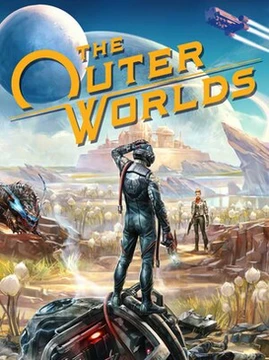
The Union Propaganda
The story the Union tells is the only story the Union lets you hear.

The Union Propaganda is the information-control apparatus of the Union, the corporate-oligarchic government that rules Halcyon Station and its surrounding colonies. Rather than a single character or cell, it is a system: a network of broadcasts, signage, curated news feeds, and messaging designed to keep the station's population compliant, grateful, and unaware of the harsher realities of corporate governance. It is the voice the player hears on every screen, the poster on every wall, the reassuring tone that frames the Union's authority as benevolent stewardship.
In the broader narrative of The Outer Worlds, the Union Propaganda functions as both a worldbuilding device and a thematic spine. It reminds the player that power in this universe is maintained not only through force but through the careful management of what people believe. Challenging the Union means challenging the story it tells, and the game's branching outcomes hinge on whether the player reinforces, subverts, or dismantles that narrative.
- Faction
- The Union
- Role
- Ruling government of Halcyon Station and the colonies
- Primary method
- Propaganda, media control, and public messaging
- Territory
- Halcyon Station and surrounding colony settlements
- Player relationship
- Allied faction or antagonist, depending on choices
- Thematic role
- Corporate authoritarianism and information control
Lore & Background
The Union's propaganda machine is woven into the fabric of Halcyon Station. Every corridor is lined with placards praising the Union's stability; every terminal defaults to a curated news feed that frames the Union's decisions as inevitable and beneficial. The tone is always calm, always optimistic, always subtly dismissive of dissent. It is the sound of a corporation that has decided the population is an audience, not a constituency. The messaging emphasizes order, progress, and the Union's role as the sole protector against the chaos of the outer colonies.
What makes the Union Propaganda thematically rich is its contrast with the player's lived experience. As you travel the planet, you see the cracks: underfunded settlements, exploited workers, factions that the official narrative paints as threats or irrelevance. The propaganda does not lie so much as it curates, omitting, reframing, and smoothing. It is the rhetoric of a power that knows it cannot be loved, so it engineers consent. The Union's broadcasts speak of unity while the Union Council deliberates in closed session; they promise prosperity while the station's infrastructure shows its age.
The player's journey through the game is, in part, a journey of seeing through that curated lens. Every faction you meet on the planet has its own version of the truth, and the Union's version is simply the one with the most amplification. The propaganda is not a villain in the traditional sense; it is a tool, a habit, a reflex of institutional self-preservation. And like all tools in The Outer Worlds, what it does depends entirely on who is holding it and what they intend to build with it.
In Their Own Story
The broadcast room on Halcyon Station hums with the low blue glow of a dozen screens. A communications officer adjusts the wording on a station-wide bulletin, swapping the word 'relocation' for 'redeployment' because the latter sounds less like a forced eviction. Outside the glass, the station's corridors stretch in their familiar grid, and a worker pauses to read the new placard: 'THE UNION PROVIDES. THE UNION PROTECTS. THE UNION REMEMBERS.' The worker nods, not because the words convince her, but because the alternative is to question why the lights in her sector have been dimmed for three cycles. The officer finishes the edit, queues the broadcast, and sips cold coffee. Somewhere on the planet, a faction leader is preparing a speech that will call the Union what it is. The officer does not hear it. The officer is not meant to hear it. The screens glow on, steady and blue, and the station carries on, believing the story it has been told because no one has been given the bandwidth to tell another.
Reader's Guide
The Union Propaganda represents the Union's ideological core: order through controlled narrative, stability through managed consent, and authority through the quiet suppression of alternative voices. In-game, the Union is one of the primary factions the player engages with throughout the campaign. Their propaganda is not a separate questline but a persistent layer of worldbuilding that colors every interaction on Halcyon Station and frames the Union's demands as reasonable and necessary.
The Union is led by the Union Council, a collective leadership that governs from Halcyon Station. Their territory encompasses the station itself and the colonial settlements they administer. Key interactions with the Union involve the player being asked to support their authority, suppress rival factions, or help maintain the station's public image.
If the player sides with the Union, they gain access to Union resources, station-level support, and a narrative outcome in which the Union's grip on the colonies is reinforced. The propaganda becomes stronger, and dissent is quietly erased. If the player opposes the Union, the propaganda apparatus becomes a target: the player may work to expose its messaging, support rival factions, or dismantle the Union's control entirely. This path carries greater risk in the short term but opens broader faction alliances on the planet. The game's branching structure means the player's alignment with the Union's narrative directly shapes the political landscape of the ending.
Did You Know?
- The Union's propaganda is visible in nearly every interior space on Halcyon Station, from corridor posters to terminal news feeds, making it one of the most pervasive pieces of environmental storytelling in the game.
- The Union's messaging consistently frames its authority as benevolent and protective, even as the player witnesses the harsher realities of colonial governance firsthand, creating a deliberate narrative dissonance.
- The player's final alignment with or against the Union's narrative has tangible consequences on which factions survive and how the political structure of the colonies is resolved.
- The Union Propaganda serves as a thematic parallel to real-world media manipulation, using the game's satirical tone to comment on how institutions manufacture consent through repetition and curated framing.
More in Factions & Organizations
Elsewhere in the The Outer Worlds universe
Spotted an error? Know more?
This is a living reference — every entry is fact-audited, and reader corrections feed straight into our audit queue. Suggest an edit · See this site's audit record